Letting a Jump Box Kill Itself
- Idle infrastructure is still infrastructure you’re paying for.
- If you rely on memory or discipline, you will eventually fail.
- Letting systems enforce boundaries is often kinder than trusting yourself to do it later.
I wanted a control plane I could turn on when I needed it and forget about when I didn’t.
Not pause.
Not remember to shut down.
Forget.
What I ended up building was a jump box that powers itself off when I stop using it. Not gracefully. Not politely. It just… shuts itself down.
This post isn’t a tutorial. It’s a reflection on why I needed that behavior, and what it taught me about cost, discipline, and designing systems that assume human failure.
The problem wasn’t cost. It was attention.
This wasn’t about saving a meaningful amount of money.
A single DigitalOcean droplet running idle is not going to bankrupt me. I knew that. What bothered me wasn’t the bill.
It was the mental overhead.
Every time I spun up the ops host, a background thread started running in my head:
“Did I shut that down?”
“I’ll remember later.”
“I should check.”
That’s not operational clarity. That’s cognitive tax.
The problem wasn’t infrastructure cost. It was attention leakage.
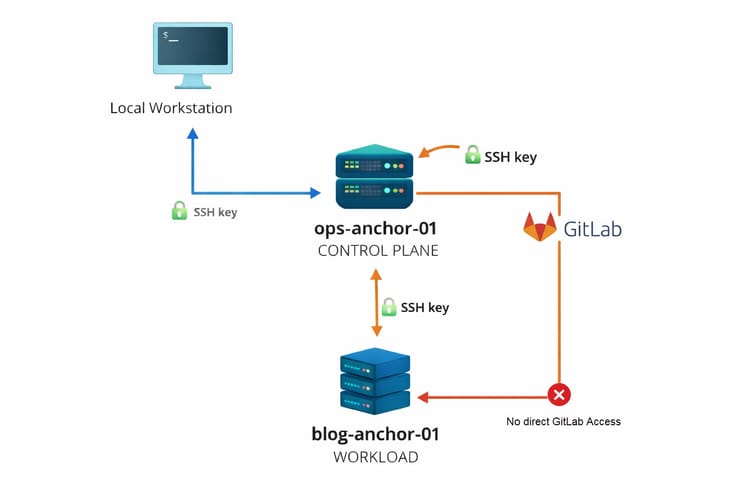
I already had a control plane. That wasn’t the issue.
I had already separated concerns:
- Local machine → ops host
- Ops host → workload machines
- No reverse trust
The control plane was intentional, documented, and narrow in scope. That part felt solid.
But there was still a loose end.
The ops host lived forever unless I intervened.
That made it different from the rest of the system. Everything else had constraints. This didn’t.
Humans are bad at cleanup
I tried to tell myself I would just remember to power it off.
That worked exactly as well as you’d expect.
Sometimes I did.
Sometimes I didn’t.
Sometimes I meant to and got distracted.
The lesson wasn’t new, but it was uncomfortable: systems that rely on human discipline eventually fail.
So I stopped trying to fix myself and fixed the system instead.
The rule I introduced
The rule is brutally simple:
If I am not actively using the ops host, it should not exist.
No grace period.
No confirmation dialog.
No “are you sure?”
If I’m idle long enough, it shuts itself off.
That’s it.
Why I didn’t add a safety net
I briefly considered adding:
- Grace periods
- Interactive warnings
- “One last chance” prompts
And then I didn’t.
Because those are just ways to smuggle human indecision back into the system.
If I need the machine, I can start it again in seconds. That is cheaper than keeping it alive “just in case.”
This wasn’t about preventing failure. It was about making failure cheap and reversible.
Watching it work was uncomfortable
The first time it powered itself off while I was mid-thought, I was annoyed.
The second time, I laughed.
The third time, I stopped caring.
That’s when I knew it was working.
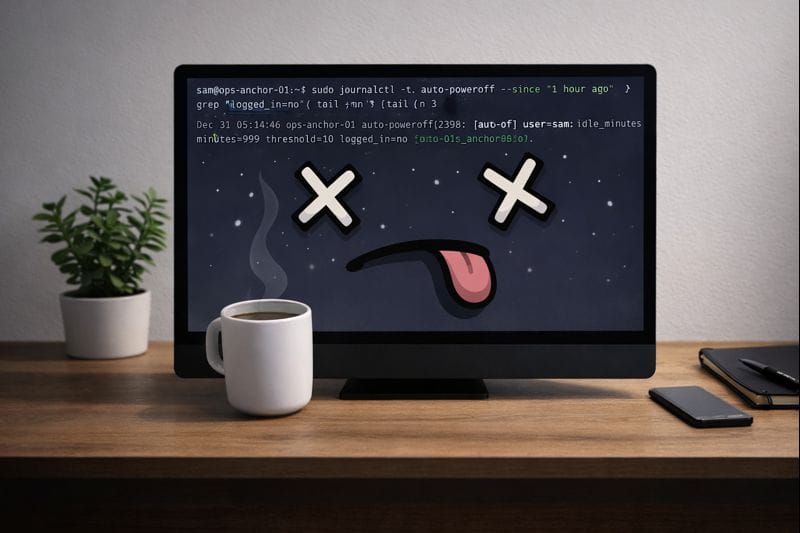
The logs told a clear story:
Idle time increasing
No active sessions
Threshold reached
Power off
No ambiguity. No guessing.
The system didn’t argue with me. It just enforced the rule.
What this unlocked
Once the jump box became ephemeral, a few things shifted:
- I stopped worrying about cost entirely
- I stopped “babysitting” infrastructure
- Spinning the environment up felt intentional again
Most importantly, I stopped negotiating with myself.
The system had an opinion, and it wasn’t interested in my excuses.
This wasn’t about automation
Just like the control plane work before it, this wasn’t really about bash scripts or timers.
It was about designing systems that assume:
- I will forget
- I will get distracted
- I will optimize for convenience in the moment
Good systems don’t shame that. They account for it.
Final takeaway
The best infrastructure decisions I’ve made recently weren’t about features or scale.
They were about removing choices.
If something should not exist idle, don’t rely on memory. Encode the rule and move on.
Sometimes the most humane thing you can do is let the machine kill itself so you don’t have to think about it.
While drafting this post, the jump box shut itself off again. I didn’t notice until my SSH session vanished, which felt like the most honest validation possible.